

Where I've Been
First, a personal note: I've been silent for the past five months, sorry. The irony isn't lost on me—disappearing during one of the most transformative periods in AI adoption to date. The truth? I've been completely immersed in the trenches: leading enterprise AI implementation projects, conducting intensive training programs for executive teams, and developing AI literacy frameworks, strategies, and everything in between for organizations trying to navigate this new landscape.
The good news? These months of hands-on work, the kind I've now been doing for over 20 years, have again given me valuable insights into how organizations are integrating AI currently—not the sanitized version you read about in case studies or LinkedIn, but the messy, complicated reality of transformation in progress. Which is very, very different from former phases and years. One of these aspects will be our topic today.
And in the spirit of another fresh release from Anthropic, Claude 4 is here and of course it helped to write this piece.
Now, back to our regularly scheduled programming.
The Extinction of the "Prompt Engineer" Job Title, if there ever even was one….
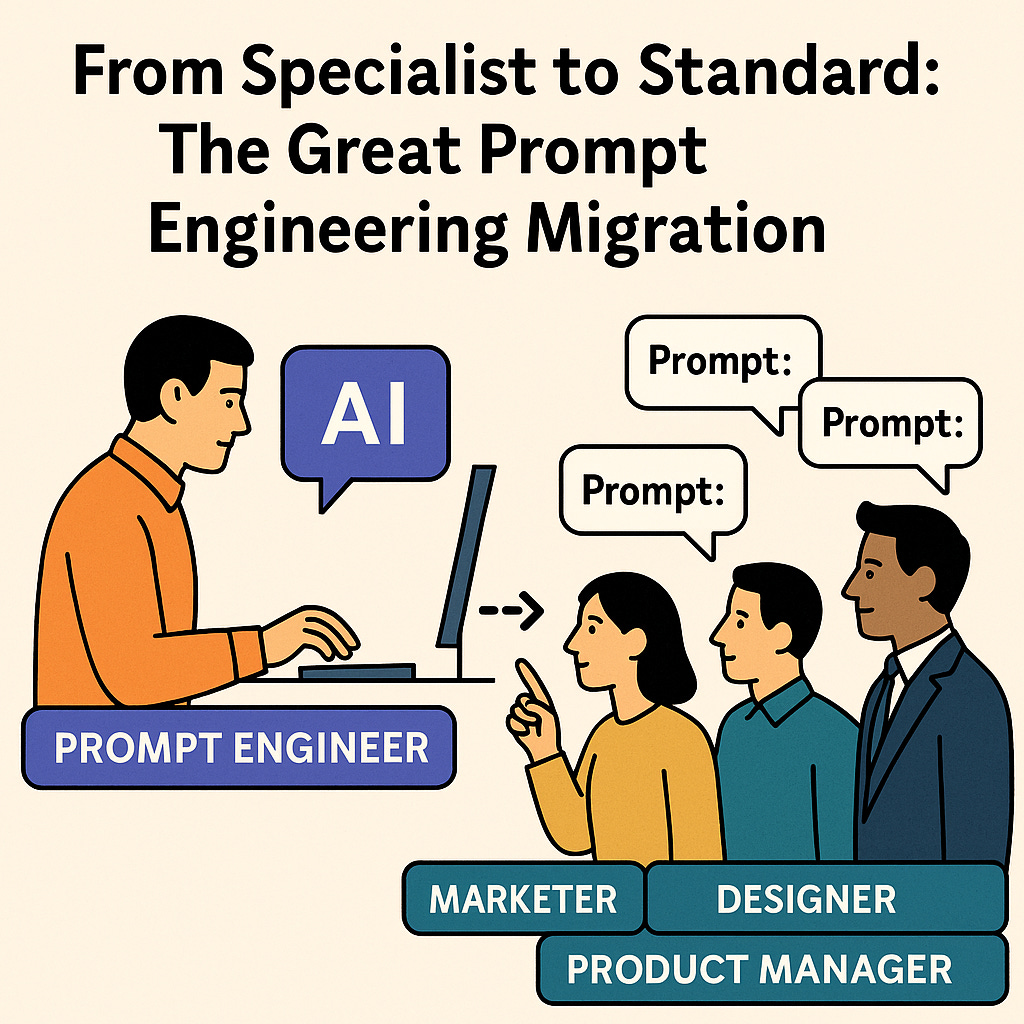
Let's start with the cold, hard truth: the "prompt engineer" as a standalone job title is dead. Not evolving. Not transforming. Dead.
As Fast Company recently reported (May 6, 2025), dedicated prompt engineering roles have all but vanished. Indeed, economist Allison Shrivastava confirmed what many of us suspected: these roles "never [were] a large enough title to track mathematically." The burning question isn't when prompt engineering jobs disappeared—it's whether they ever truly existed beyond LinkedIn fantasies and recruiting buzzwords. Autsch!
Malcolm Frank, CEO of TalentGenius, put it bluntly: "AI is already eating its own." He aptly compares prompt engineering to "Excel wizard" or "PowerPoint expert"—valuable skills, but not standalone roles companies really hire for or should hire for. It shows time and again that we lack a proper understanding of AI. Yes, OpenAI employs such people, but would you hire a mechanical engineer for your marketing agency just because you own five cars?
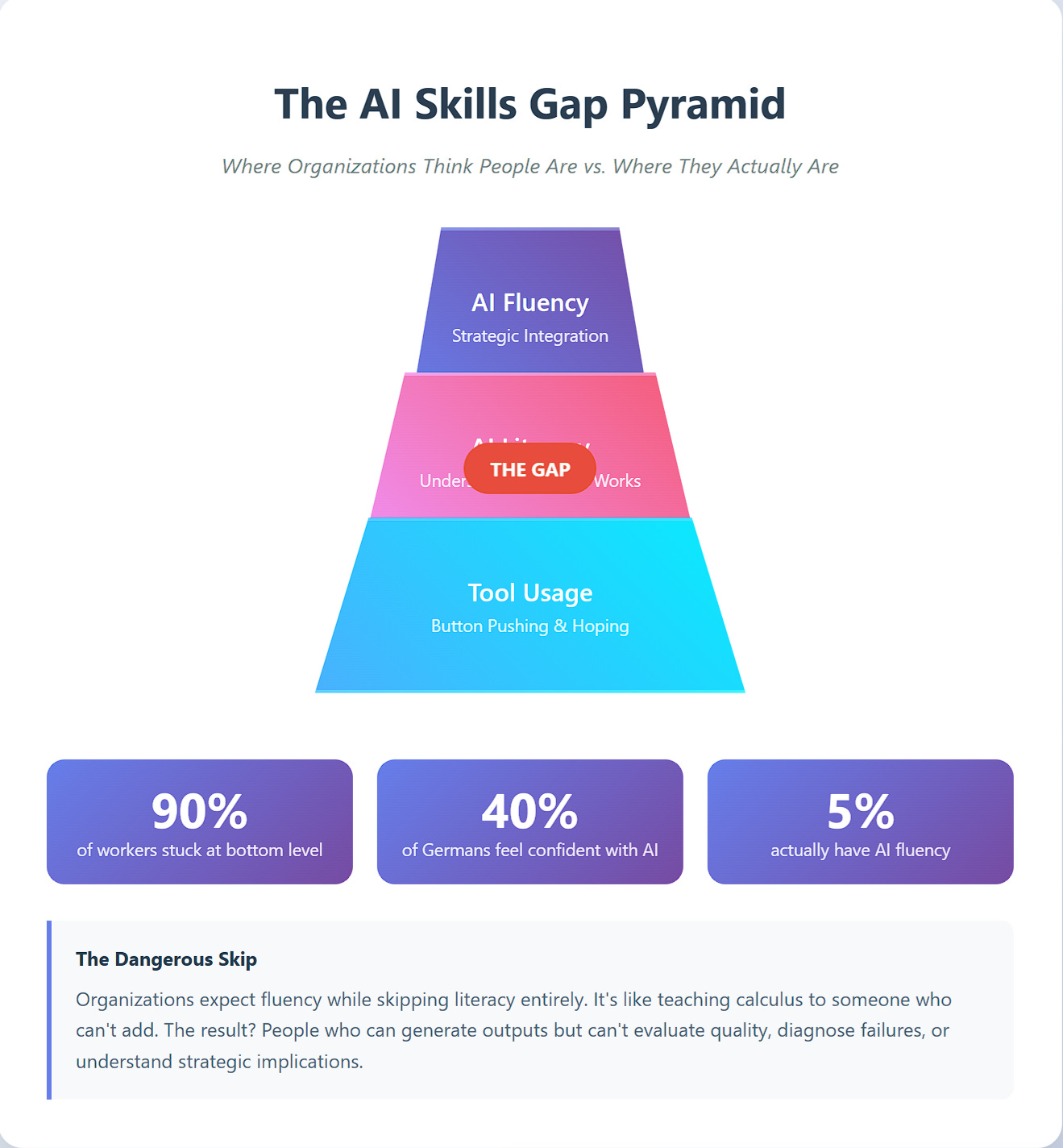
The job title died because the need itself has migrated. And this is not really clear for quite a lot of people. If you look at roles and job descriptions of knowledge workers, 90% would now require AI prompting skills, but how many of these professionals have any idea what they're doing?! And we're not even talking about AI literacy or let's go bold: AI fluency.
This gap isn't just uncomfortable—it's a full-blown workplace crisis.
Quick Note on Terminology
Throughout this article, I use both "prompting" and "prompt engineering":
Prompting: The basic act of giving instructions to AI systems
Prompt Engineering: The systematic approach to designing, testing, and optimizing those instructions for specific outcomes
While everyone now needs to know how to prompt, true prompt engineering involves more technical understanding of how these systems work and respond. And here it kind of starts, how many skills do you really need and in which fields?
Prompting Isn’t Dead—It’s Just Infiltrated Every Job You Have
Here's the new reality: prompt engineering didn't disappear—it dispersed. What was briefly pitched as a specialist role has rapidly transformed into a universal expectation.
Consider:
Marketing teams are expected to craft their own sophisticated prompts
Designers directly instruct AI tools with zero intermediaries
Product managers incorporate prompting into daily workflows
Executives use AI assistants for decision support
Developers integrate prompt templates into applications
Oh and don't forget the whole vibe coding discussion!
As Fast Company noted, strong AI prompting is "simply an expected skill, not a stand-alone role." It's "turned from a job into a task very, very quickly."
But here's the problem: while companies have distributed the responsibility, they haven't distributed the expertise.
It's More Than Just Talking, and let's focus for a bit on The Skill Gap Crisis
The most dangerous misconception in today's workplace? That prompt engineering is "just talking to AI."
This thinking creates the bizarre situation where:
Companies expect everyone to use AI effectively
Nobody receives formal training in how to do so
Performance varies wildly across teams
Everyone thinks they're an expert because they can type
Let's be brutally honest and repeat myself: most people are terrible at prompting AI. They approach it with the precision of a toddler using a smartphone—pushing buttons until something happens, with no understanding of how or why it works.
I see examples of poor prompting daily in my work as a Data & AI strategist:
The marketing manager at a Mittelstand company who asks for "creative content" without specifying audience, tone, or purpose
The analyst at a major automotive supplier who dumps entire spreadsheets into AI tools without any contextual framing
The executive at a financial firm who requests "strategic insights" without defining industry parameters or decision criteria
The developer at a Berlin tech startup who writes vague requirements like "make this code better" instead of specifying performance targets
These aren't fictional scenarios—they're real examples from organizations trying to integrate AI without developing proper prompt competency. And let's not forget, the BYAI - Bring Your Own AI Drama, guess what happens if you roll out the nightmare called Microsoft Copilot or just plain block any use of GenAI - people still use it in the most unsafe and ineffective ways!
We Trained the Machines—Now We’re the Ones Who Need Training
Back to prompting and the baseline understanding needed:
Effective prompt engineering requires:
Structural understanding: Knowing how to frame queries for specific outcomes
Context management: Providing the right information at the right level of detail
Output control: Setting clear parameters for format, length, and style
Error diagnosis: Identifying why prompts fail and how to fix them
Verification protocols: Establishing methods to validate AI outputs
These aren't intuitive skills—they're learned competencies that require practice, feedback, and systematic approaches. This explains why, according to the latest KPMG study, Europeans struggle more with AI trust and effectiveness compared to global averages: we're trying to master the outputs without understanding the inputs.
Repeat after me: we're trying to master the outputs without understanding the inputs. And with no clue how the machines really work!
The Missing Link: AI Literacy vs. Fluency
Before we continue, we need to address the elephant in the room: prompting is not AI literacy.
This distinction is critical and it's a fundamental misunderstanding that's undermining organizational AI adoption:
AI Literacy: Understanding how AI systems function, their capabilities, limitations, and underlying principles
AI Fluency: The strategic integration of AI principles and capabilities into decision-making and organizational practices; applying AI understanding at a higher level to transform how you work
Most companies are trying to skip both literacy and fluency, jumping straight to superficial tool usage—like teaching someone to press buttons on a calculator without understanding math. The result? People who can generate outputs but can't evaluate their quality, relevance, or strategic implications.
This approach fails because:
Without understanding how large language models process information, users can't diagnose why their prompts fail
Without knowing what models can and can't do, teams waste time on impossible requests
Without awareness of how context windows function, users overwhelm systems with irrelevant information
Without recognizing hallucination patterns, organizations accept flawed outputs
The reality is stark: poor prompting skills can't improve until users develop basic AI literacy. You can't effectively communicate with a system you fundamentally don't understand. And as if the irony isn't already clear, what most organizations call "AI fluency" is actually just superficial tool operation. True fluency requires literacy as its foundation. You can't strategically leverage a technology you fundamentally don't understand.
The AI Literacy Paradox
This literacy crisis is particularly acute in the "developed" first world. Take Germany as an example: back again to the latest KPMG/University of Melbourne global study on AI trust reveals that only about 40% of Germans report feeling they can effectively use AI tools, compared to 60% globally. Yet, despite this knowledge gap, we're still adopting AI at significant rates in our workplaces, and by the way only 20% have formal or informal training. Okay great and the question arises: what the hell are we adopting here?!
Let's call it the "AI Paradox" – we're increasingly using tools we fundamentally don't understand, creating a perfect storm of inefficiency, risk, and wasted potential. If you've ever sat in a meeting where everyone nods enthusiastically about "implementing AI" while nobody can explain how to actually do it effectively, you've witnessed this paradox firsthand. Oh another sure sign: after this meeting, nothing really happens and a bottom-up approach is rolled out!
And for my German crowd, let's face it, it's even worse. The Bitkom research sadly confirms it…
The CLEAR System: Your Prompt Recovery Protocol
Let´s start with a quick fix - a nice little framework to get into skills, not copy-pasting stuff from LinkedIn, because the answer isn't collecting more prompts or memorizing magic phrases. As I wrote in "Breaking Free: Your AI Therapist's Holiday Gift," prompt hoarding creates more problems than it solves.
Instead, we need a systematic approach that works across models and survives updates while addressing concerns about transparency and accountability. You need frameworks that work and guide you through the process.
There are quite a lot of them—see the article on the prompting report—but the last few months have changed the game quite a lot, considering the models' behavior. A proper starting point in May 2025, here's the CLEAR framework, for classic LLMßs and hybrid models like Claude 3.7 and 4.0. Reasoning and Research models differ in prompting, next article incoming.
Context: One-sentence project framing (not your life story)
Limitations: Explicit boundaries (word count, format, scope)
Expectations: Specific output requirements (structure, tone, audience)
Action: Clear instruction (one main task, not seventeen)
Reality Check: Verification method (how you'll validate the output)
CLEAR in Action: Before and After
Poor prompt: "Write me a sales email."
CLEAR prompt: "Context: Follow-up email for prospects who downloaded our manufacturing automation whitepaper. Limitations: Under 200 words, professional tone, no technical jargon. Expectations: Structured with clear value proposition, addressing cost concerns, targeting mid-level managers in German manufacturing. Action: Create email that moves prospects to schedule a 15-minute consultation call. Reality Check: I'll test this with our current prospect list and measure open/click rates against our baseline."
This isn't just another acronym—it's a cognitive framework for thinking about AI interactions that transfers across models, tools, and updates. It's particularly valuable for organizations because it creates the transparency and accountability that recent studies show we value deeply in our approach to technology. Think about your next prompting coffee get-together.
How Organizations Are Failing (And How to Fix It) - from personal responsibility to organizational approaches
If prompt engineering is now everyone's job, organizations need to treat it that way.
This is why we have to take a broader, more top-level view to get the full picture. Otherwise, you end up blaming yourself rather than the system, which is never a good idea, even if it often means you still have to improve your skill set on your own.
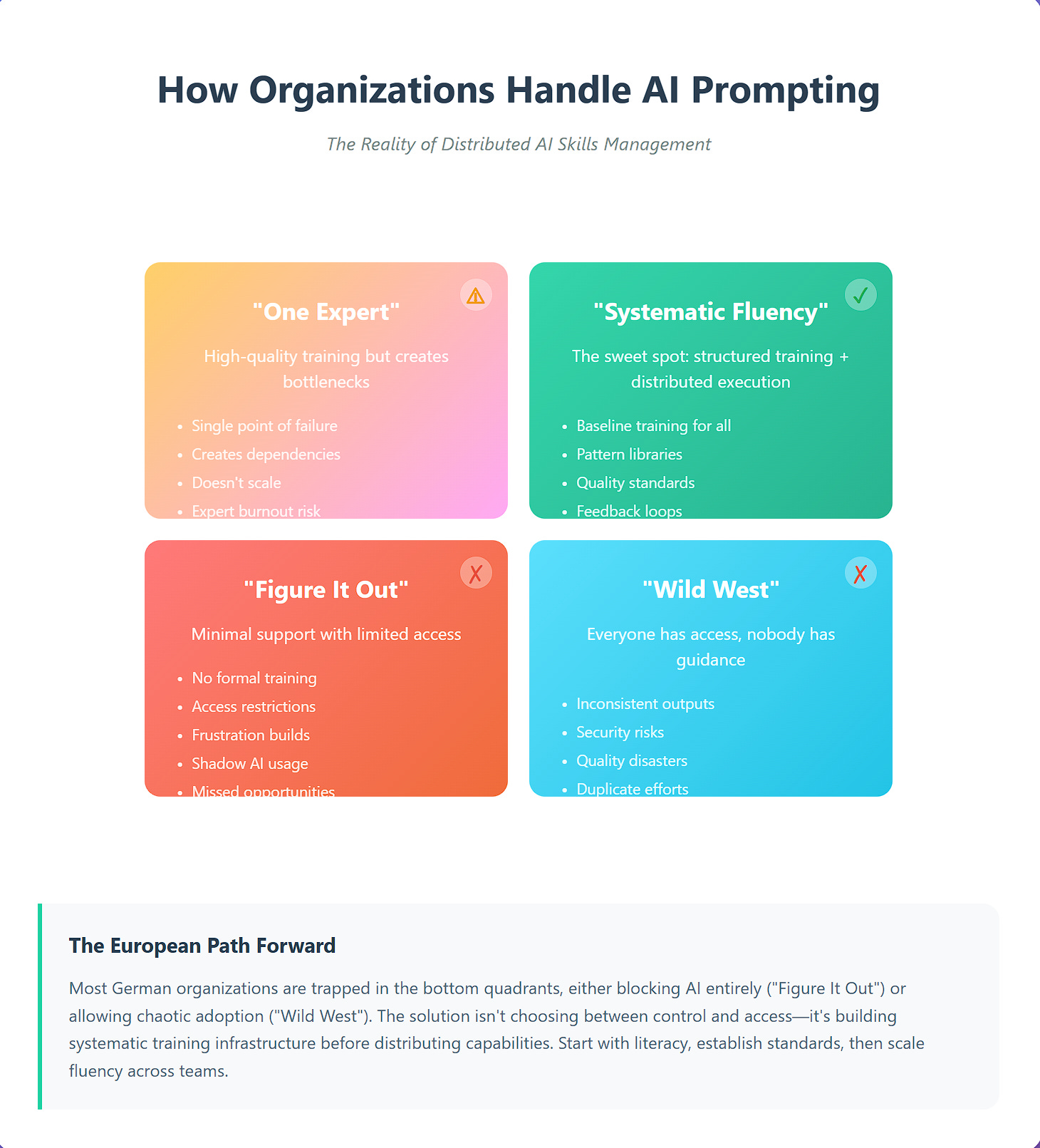
What we currently, most are taking one of two disastrous approaches:
The "Figure It Out" Approach:
No formal training
No standardized methods
No quality controls
No shared resources
The "One Expert" Approach:
One person handles all prompting needs
Creates bottlenecks
Doesn't scale
Builds single point of failure
The "Wild West" Approach:
Everyone gets AI access without training
No oversight or quality controls
Teams create their own "solutions"
Massive inconsistency across departments
Security and compliance nightmares
The "Systematic Fluency" Approach:
Structured baseline training for everyone
Clear standards and verification protocols
Distributed execution with centralized excellence frameworks
Continuous feedback and improvement cycles
Measurable skill development across teams
The solution? Organizations need to implement:
Baseline Training: Everyone needs prompt fluency fundamentals
Pattern Libraries: Company-specific templates for common tasks
Quality Standards: Verification protocols for AI outputs
Feedback Loops: Systems to improve prompt effectiveness
Skill Assessment: Ways to measure prompt competency
The Future of Prompt Competency
Malcolm Frank describes AI as "almost like Pac-Man just moving along and eating different tasks and different skills." While AI advocates have long claimed it will create as many jobs as it destroys, prompt engineering's rapid rise and fall tells a different story.
Rather than creating entirely new roles, AI is reshaping existing ones—adding new required skills to jobs people already have. This means:
Everyone needs to develop prompt fluency
No one gets the luxury of specialization
The skill gets embedded, not isolated
The best prompting becomes invisible
The paradox: the better you get at prompt engineering, the less it looks like you're doing anything special at all. The best prompt engineers have systematic thinking patterns that produce reliable results.
Your Action Plan
Stop collecting prompts: Delete that folder of "perfect prompts" right now (yes the one you got on LinkedIn)
Build systematic thinking: Focus on patterns, not specific phrases
Create personal templates: Develop your own reusable frameworks
Test ruthlessly: Validate every approach with real results
Share knowledge: Establish prompt standards in your team
Learn verification methods: Know how to check AI outputs
Address your trust gap: Recognize and mitigate specific European concerns about AI
Let's look at a few of these in more detail:
Build systematic thinking: Instead of asking "Write me a sales email," develop a mental template: "Create a [length] sales email for [specific audience] highlighting [key benefit] with a focus on [emotional tone] and a clear [call to action]." The difference is night and day.
Create personal templates: Maintain a simple document with your core prompt patterns like CLEAR for different tasks. Or as another example, my content analysis template for a major German manufacturing client follows this structure:
Objective: What am I trying to learn?
Format: How should the analysis be structured?
Focus areas: What specific elements need examination?
Constraints: What should be excluded or limited?
Output format: How should findings be presented?
Address your trust gap: The KPMG study shows that Germans and Europeans trust AI less than global averages. This isn't irrational—it's a reasonable response to legitimate concerns. However, it does require conscious effort to bridge this gap. Document your verification methods, create responsibility matrices for AI-generated content, and establish clear boundaries for what AI should and shouldn't do in your organization.
By starting with these foundations, you save time and get consistently better results than colleagues who start from scratch each time.
Remember: In the AI era, the most valuable skill isn't knowing all the answers—it's knowing how to ask effective questions. It's everyone's job now, the only question is whether you'll be good at it or not.
How is your organization handling the prompt engineering skill migration? Are you seeing it transition from a specialized role to a distributed skill? Share your experiences in the comments, or just tell me about your most catastrophic prompt failure. I promise not to judge (much).
And for the German-speaking crowd, dates are here
P.S. If you're still hoarding prompts like they're limited edition Pokémon cards, please revisit my article on "Breaking Free: Your AI Therapist's Holiday Gift" for your prompt intervention. Your bookmark folder needs therapy.
P.P.S. If you enjoyed this analysis of the prompt engineering extinction event, you might also like my deep dive into "When Prompts Go Wrong: A Formal Analysis of AI Communication Patterns" - consider it your diagnostic manual for the new prompt normal.